
Jakarta (UTC+7) | Yufy Firdiansyah, S.Sos., M.M
The Radar & G8 Macro tab on Currenomy provides an institutional-grade snapshot of global market conditions, interest rate differentials, and central bank stances helping traders establish a high-probability directional bias before executing trades.
Macro & Global Environment
The top-left panel tracks key intermarket metrics to determine global risk sentiment. High US 10-Year Yields paired with falling Gold Spot and a low VIX Index signal a PRO-RISK regime. In this environment, risk-on currencies tend to gain traction while safe-haven assets face headwinds.
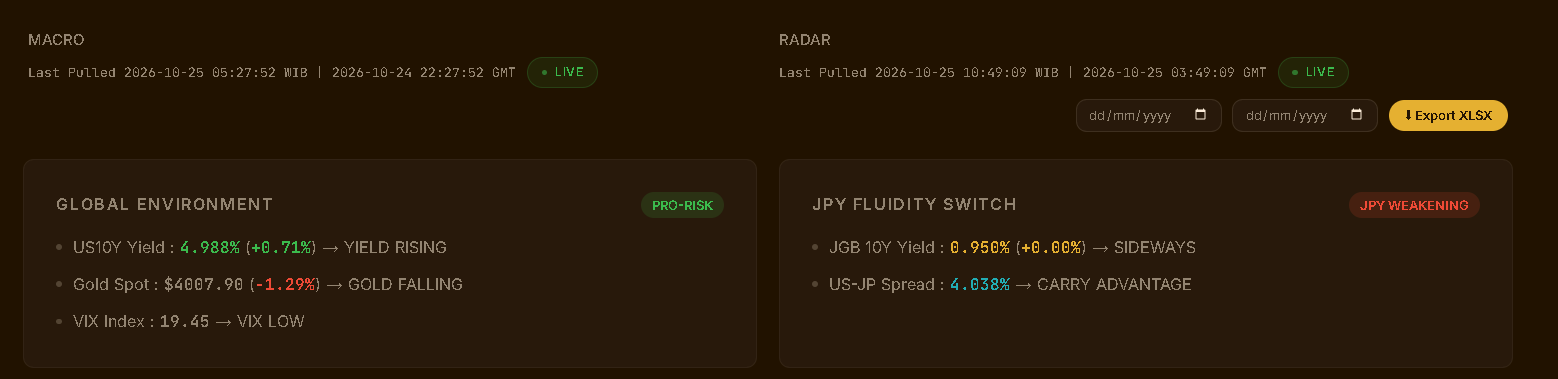
The top-right panel focuses on Japanese Yen dynamics by evaluating the US-JP yield spread. A widening spread highlights a strong CARRY ADVANTAGE, signaling a JPY WEAKENING bias. This gives traders an instant edge when pairing the Yen against higher-yielding currencies.
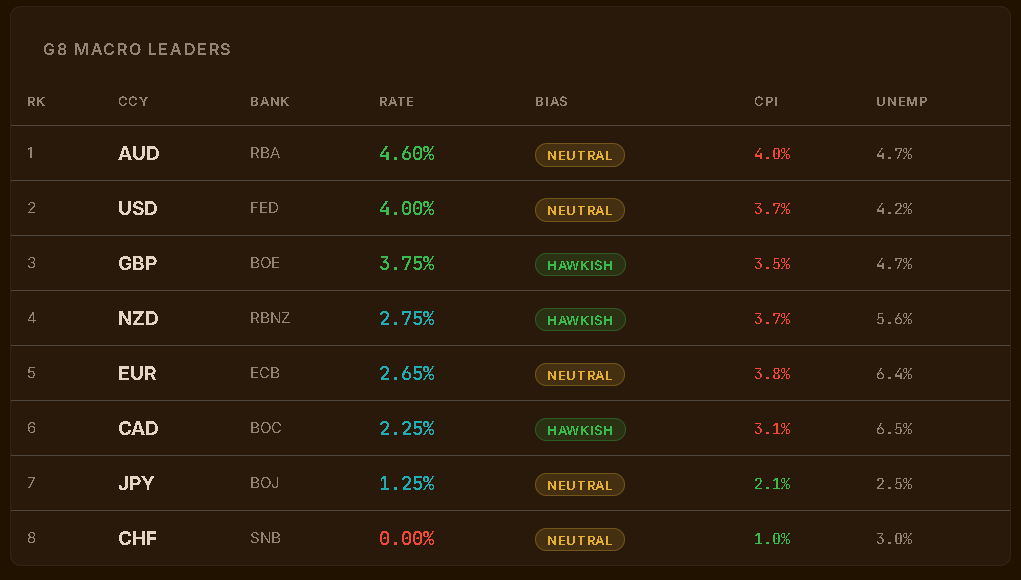
G8 Macro Leaders
The bottom panel ranks the G8 currencies based on macroeconomic fundamentals and central bank policy stances:
1. RK & CCY: Displays currency rankings from strongest fundamental support to weakest.
2. RATE & BIAS: Highlights key central bank interest rates alongside qualitative policy stances (HAWKISH vs. NEUTRAL). Hawkish biases (e.g., GBP, NZD, CAD) indicate potential tightening or yield support, whereas neutral stances reflect balanced policy outlooks.
3. CPI & UNEMP: Tracks inflation levels against unemployment data to gauge economic momentum and potential central bank shifts.
Filter for strong fundamental divergence by pairing top-ranked currencies with hawkish stances against weaker or lower-yielding currencies under favorable global risk environments.
Pair Velocity: Interest Rate Differentials & Policy Alignment
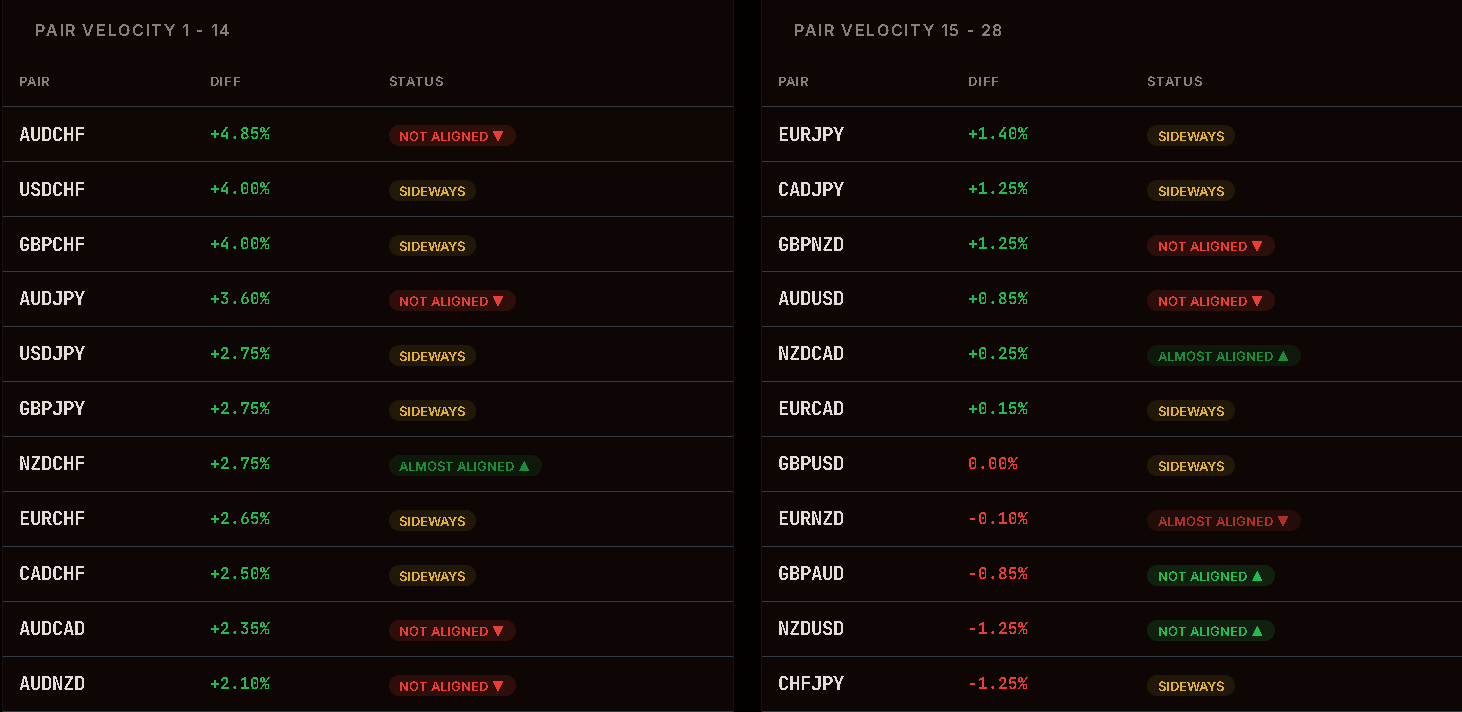
Pair Velocity measures the interest rate differential between the base and quote currencies.
Carry Trade Mechanics: Positive differentials (e.g., AUD/CHF at +4.60 favor carry trade setups in Risk-On regimes.
Conversely, negative differentials tend to appreciate during Risk-Off environments and decline in Risk-On conditions.
Central Bank Alignment: The status indicator evaluates monetary policy stance:Full/Almost Aligned: Achieved when a hawkish base currency (tightening/quantitative tightening) is paired with a dovish quote currency (rate cuts/loose policy).
Pairs like GBP/CHF +3.75 and CAD/JPY +1.00 display strong structural alignment. Sideways & Not Aligned: Divergent or neutral central bank dynamics result in mixed signals (e.g., AUD/JPY or USDCAD), pointing to rangebound price action.
Visit Currenomy.com to get insights for analyzing the strength of G8 currency pairs.
Disclaimer: Content for educational purposes only. DYOR (Do Your Own Research). Not financial advice. Trading involves risk of loss.
#Currenomy #CurrenomyTerminal
#MacroEconomics #ForexTrading #RetailTraders #Inflation #CPI#BondsAndYields #InterestRates #Inflation #CentralBanks #CurrencyTrading #StockMarket #ForexEducation #FinancialLiteracy #COT #CommitmentOfTraders #TradingStrategy #DYOR